
The Choir Director
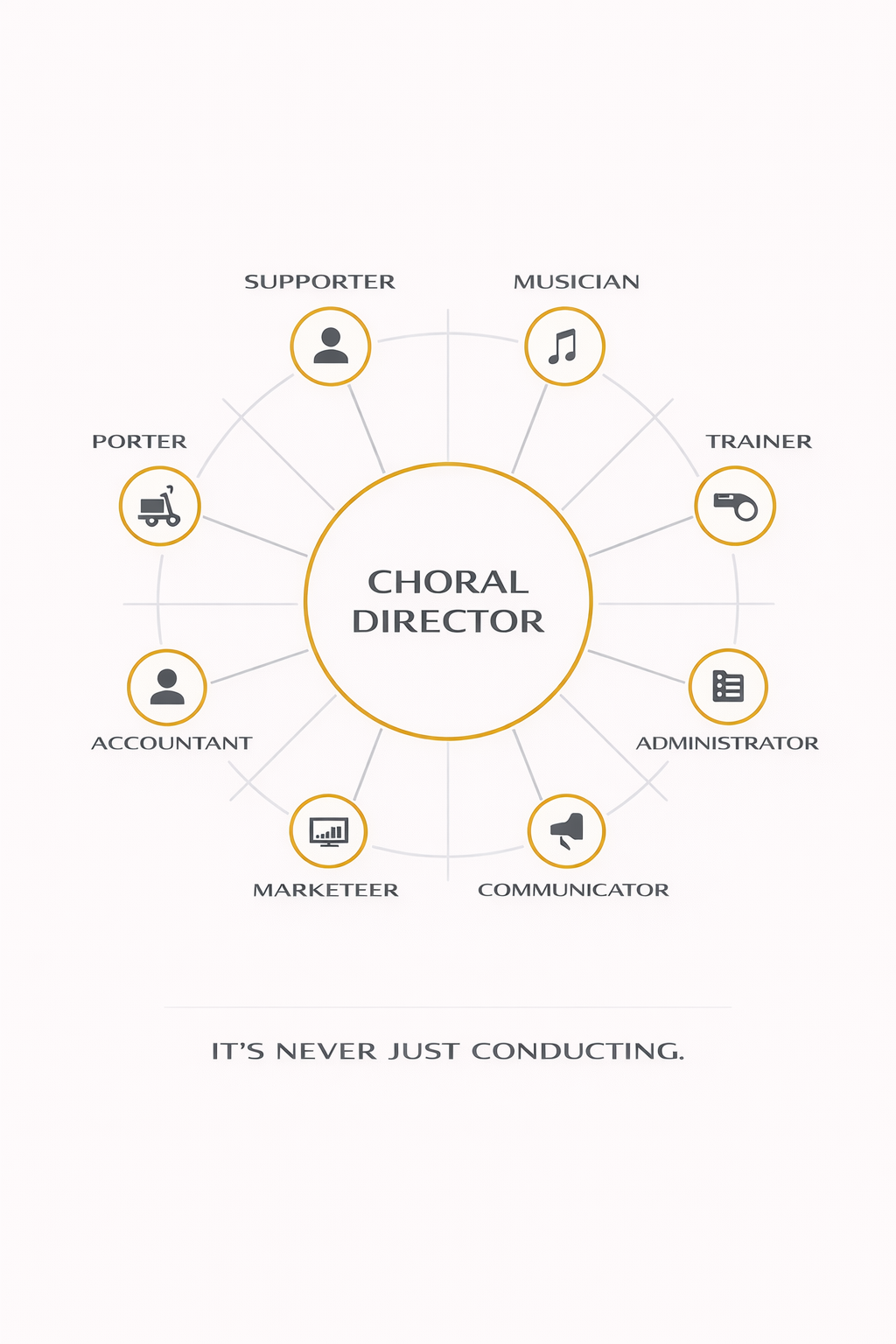
To describe someone simply as a “choral conductor” feels, at best, incomplete.
Because the reality is rather more complex.
A choral director is, of course, a musician.
They study scores.
They shape sound.
They think about balance, blend, and interpretation.
They stand in front of a choir and make music.
But that is only part of the role.
They are also a teacher.
Explaining.
Demonstrating.
Finding ways to help singers understand not just what to do—but how and why.
Developing individuals and ensembles over time.
They are a choir trainer.
Building technique.
Encouraging listening.
Establishing habits that lead to consistency and confidence.
They are, at times, an administrator.
Organising rehearsals.
Planning programmes.
Managing logistics that are essential—but rarely visible.
They are often a communicator.
Writing emails.
Keeping people informed.
Maintaining clarity and connection beyond the rehearsal room.
They are sometimes a marketeer.
Promoting concerts.
Building audiences.
Finding ways to ensure that the work being done is heard.
They may also be an accountant.
Balancing budgets.
Making decisions about resources.
Ensuring that projects are sustainable.
And frequently, they are something else entirely…….
A listener.
A supporter.
A source of encouragement.
Recognising that behind every voice is a person—with their own experiences, pressures, and reasons for being there.
None of this sits separately.
It all feeds into the music.
The way a rehearsal is organised affects its energy.
The way people are communicated with affects their engagement.
The culture that is built off the podium is heard in the sound on it.
So when we talk about choral directing, we are not just talking about conducting.
We are talking about leadership.
And leadership, in this context, is not about control.
It is about creating the conditions in which people can do their best work.
Clear intention.
Strong communication.
A shared sense of purpose.
When these are in place, the technical work becomes easier.
The musical work becomes deeper.
And the experience becomes more meaningful—for everyone involved.
Because a choir is never just a collection of voices.
It is a community.
And the role of the choral director is to shape that community—musically and beyond.
Peter Futcher
