
Repertoire: Bob Chilcott’s St John Passion
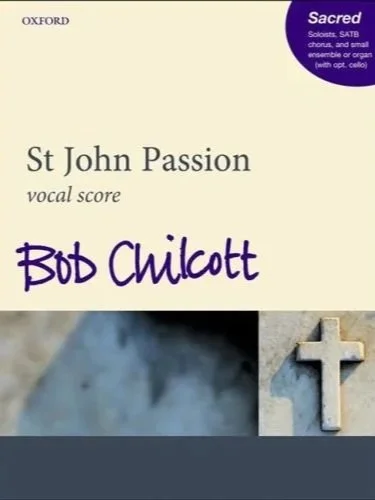
Approaching Chilcott’s St John Passion
Seasonal music often brings with it a sense of familiarity.
We return to it each year, knowing the shape, the pacing, the emotional trajectory.
Bob Chilcott’s St John Passion is no exception and is becoming a new classic.
Accessible. Immediate. Direct in its communication.
But precisely because of that clarity, it asks something very specific of the choir.
This is not music that hides behind complexity.
It is exposed.
The writing demands clarity of line, precision of rhythm, and above all, a strong sense of narrative.
At the centre of the work is storytelling.
The role of the Evangelist carries the narrative, but the choir is never simply accompanying.
It comments.
It reacts.
It becomes part of the drama.
In rehearsal, this requires a shift in thinking.
Not just:
Are we singing this accurately?
But:
What is happening here?
Who are we in this moment?
What is the emotional context?
What has just changed?
The clarity of the writing means that detail matters.
Entries must be secure.
Rhythmic precision is essential.
But accuracy alone is not enough.
Without intention, the music risks becoming flat.
There is a particular challenge in balancing simplicity and intensity.
Much of the writing is direct—sometimes deceptively so.
But beneath that simplicity is a need for commitment.
The sound cannot be casual.
It must carry weight, even in quieter moments.
Text is central.
If the words are not alive, the music cannot be.
Consonants need purpose.
Vowels need direction.
Phrases need meaning.
Encourage singers to think beyond pronunciation:
What are we saying?
Who are we saying it to?
Why does it matter?
There are also moments where the energy shifts quickly.
From reflection to urgency.
From narrative to crowd.
These transitions need to be clear.
Not exaggerated—but intentional.
Gesture plays a crucial role here.
The choir will only respond if the change is visible.
As the work unfolds, pacing becomes increasingly important.
Where is the tension building?
Where is it released?
Where do we need to hold back—and where do we need to move forward?
Without this sense of direction, the larger structure can feel episodic.
And ultimately, the question remains:
What kind of experience are we creating?
Chilcott’s St John Passion does not require over-complication.
But it does require engagement.
Clarity.
Commitment.
Connection.
When those elements are in place, the simplicity of the writing becomes its strength.
And the music speaks.
Peter Futcher
